9 Ways Organizations Can Create More Diverse & Inclusive Workplaces
9 Ways Organizations Can Create More Diverse & Inclusive Workplaces
일자
상시
유형
아티클태그
What is the one way to transform your organization into a diverse and inclusive place to work?
To help you transform your organization into a more diverse and inclusive workplace, we asked business leaders this question for their insights. From starting with inclusive core values to educating your employees, there are several ways you can help make your organization a more inclusive place to work.
Here are nine strategies for forming a more inclusive workplace:
To help you transform your organization into a more diverse and inclusive workplace, we asked business leaders this question for their insights. From starting with inclusive core values to educating your employees, there are several ways you can help make your organization a more inclusive place to work.
Here are nine strategies for forming a more inclusive workplace:
- Start with inclusive core values
- Showcase your people
- Seek feedback and measure progress
- Build community
- Let the why inform your efforts
- Stop looking for a culture fit
- Don’t dismiss employee feelings
- Champion life flexibility
- Educate your employees
Start with inclusive core values
To create an inclusive place to work, we strive to build trust and create a positive team environment. An inclusive culture is a positive one where people feel supported and that their work has a real impact on the whole. A company’s core values should also reflect this desire for inclusion. By this, we make sure that every person on our team understands that they are an integral part of the organization. So making sure that building an inclusive environment is a company priority helps us ensure that all our choices reflect those values and ideals.Showcase your people
In order to make your organization an inclusive environment, don’t be afraid to showcase people. With Curricula, we took security awareness training. We made it fun by telling stories that show off main characters of various backgrounds to reflect the diversity we have within our own company.By embracing the diversity that exists in your organization and taking the time to make sure everyone feels seen and heard, you can foster genuine relationships and conversations. Differences don’t need to be buried, as burying them only continues to deepen the wounds. Foster conversations about employee experiences and ways to better handle issues or be sensitive to different cultures.
Seek feedback and measure progress
Tracking your progress fosters an inclusive environment for your business. This initiative can take place in a staff meeting, company-wide survey, or any method you see fit. Encouraging input from all team members allows you to take a step back to see the successes and possible areas of improvement that your business is facing.Employees can rely on this resource method to use their voice, ultimately strengthening trust within your company.
Build community
The transition to civilian life and work is a unique experience for veterans just entering the workforce. Creating a community for veterans in your organization to meet, share resources, and offer mentorship opportunities to other veterans should be a priority.Employee resource groups (ERGs) such as these are not just limited to veterans, however. Any group that would like to establish an organization-supported ERG should have the opportunity to form. Organizations should make that knowledge available company-wide.
Let the why inform your efforts
First, focus on your why — the end goal of having a more diverse and inclusive workplace. By focusing on why, you can get buy-in starting from the top down with the ultimate goal of getting everyone on board. Then, with everyone’s buy-in, you can set the overall company mission, vision, and values around diversity and inclusiveness. The next step is to hold everyone accountable through regular training, activities, feedback, and review.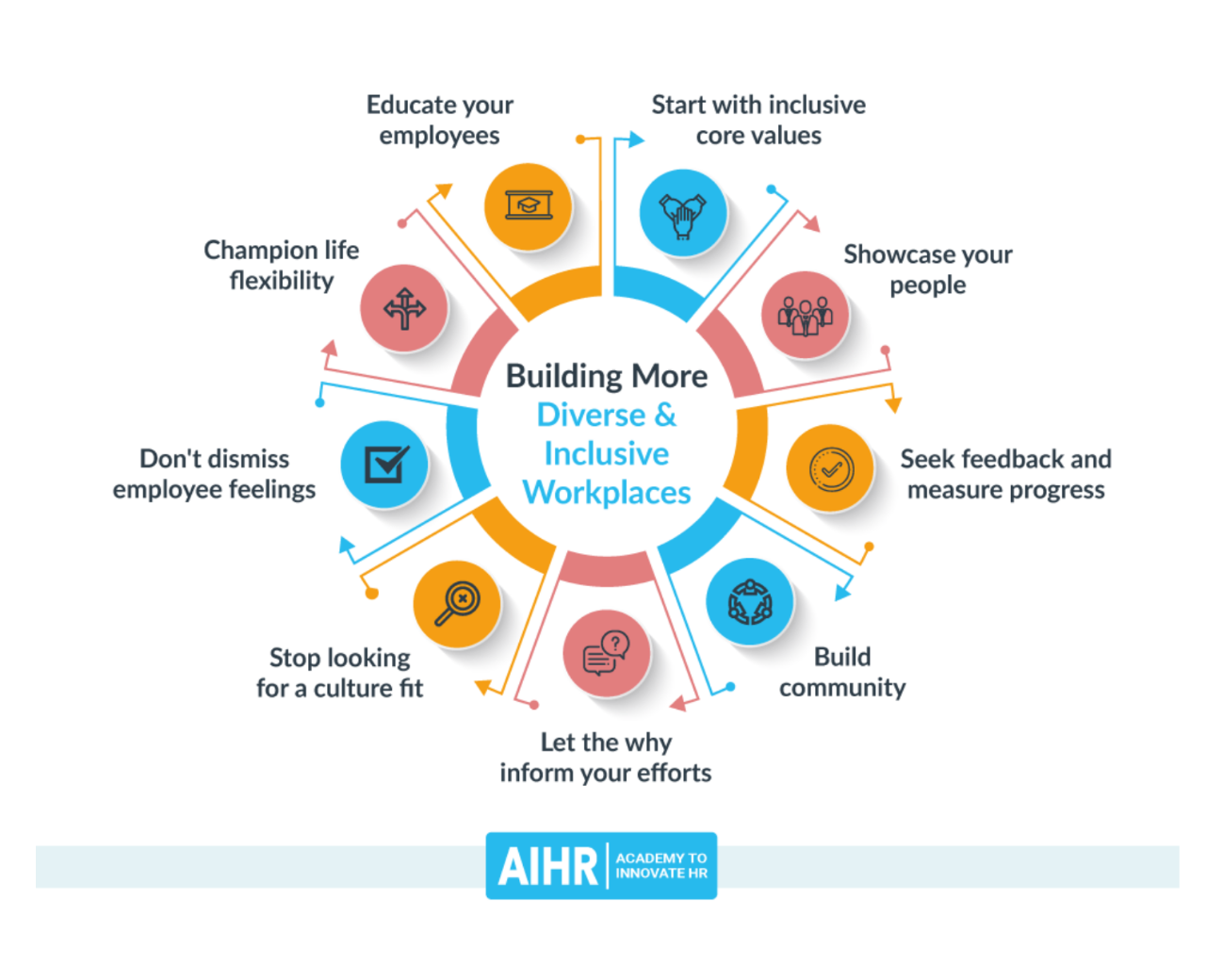
Stop looking for a culture fit
Oftentimes, when recruiting new talent, leaders look for someone who is a culture fit. But what does that even mean? If you operate in a company with a certain culture, you’ve already subconsciously ruled out people who might be different from what you’ve identified to be the norm. Everyone you hire shouldn’t be the same fit. Considering someone to be a culture fit is an antiquated phrase that no longer has space in organizations seeking to become more diverse and inclusive. If you find the company is excluding candidates based on deeming them not being a culture fit, encourage them to think differently.
Think about what is different about this candidate that is not yet represented in the workforce. Work to embrace these differences, making room for them to fit as opposed to determining they don’t fit because “we’ve never hired someone with <fill in the blank> before.”
Don’t dismiss employee feelings
If you want to build a more inclusive workplace, empathetic leadership is essential. It can be easy to overlook when employees bring up issues that are bothering them that may not seem like a big deal as a manager. But practicing empathy and thinking about how it would make you feel if you were ridiculed, excluded, or talked down to can help you better understand why it may be bothering that person.Don’t be dismissive of employees’ feelings if you want them to stay.
Champion life flexibility
We know our people have different work styles or things in their life that are very important to them. So, we champion diversity through “life flexibility” as part of our company culture. This allows our employees to have the freedom to excel based on their own unique capabilities, grow new skill sets, and go after new opportunities when they find them. They also know that they will be supported when taking on new challenges and solving problems when they arise. Business success today isn’t just about making money anymore. It’s about having a shared purpose that benefits your business, your employees, your customers, and society. For us, this provides a deeper connection to the work we’re doing.
Educate your employees
Quality mandatory training about what an inclusive workplace really means is a great place to start. Often, employees do not fully understand the terms “diversity and inclusion” from a business perspective. Training also helps to make people aware of unconscious bias, which occurs when we make judgments about people based on their gender, religion, race or other factors without realizing we’re doing it.______________________________________________________________________________________________

About the Author
Academy to Innovate HR | SKILLS FOR YOUR HR FUTURE
At the Academy to Innovate HR, it is their mission to make HR future-proof by offering world-class, online education programs available anytime, anywhere. They help organizations and individuals upskill with the modern and relevant HR skills needed to stay at the forefront of innovation and take on a more strategic role.
Click HERE to claim your 20% discount coupon!